
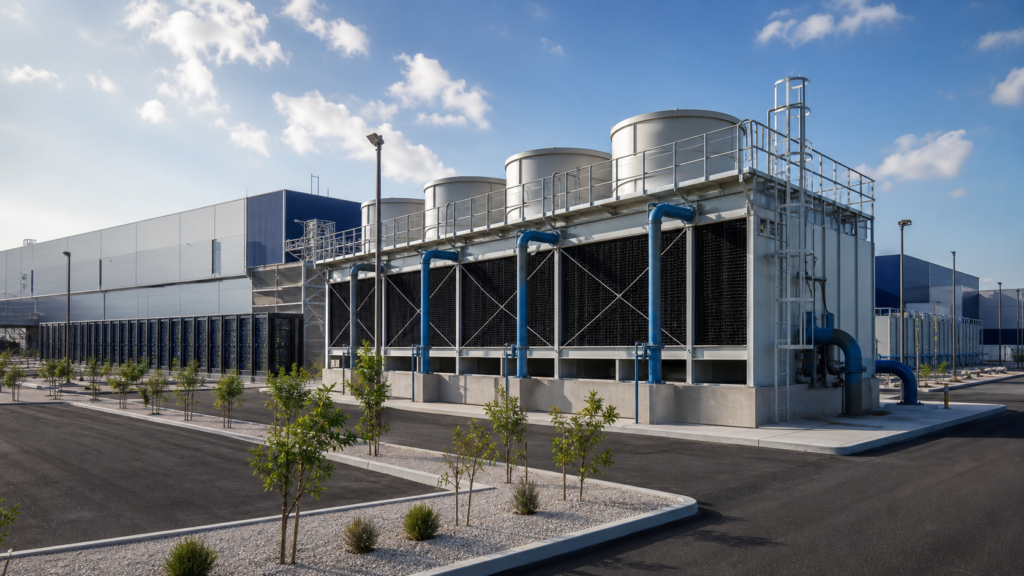
Data Center Cooling Systems for AI and High-Density Facilities
HACST supports facility-level heat rejection for data centers, AI computing clusters and high-density technical spaces. We help project teams compare closed-loop, dry and adiabatic cooling equipment around uptime, climate, water strategy, footprint and phased expansion.
Scope: HACST focuses on the heat-rejection side of the cooling plant—such as cooling towers, dry coolers, adiabatic systems and air-cooled heat exchangers. Chip-level liquid cooling, CDUs and server-room air handling should be coordinated with the wider project team.
What a Data Center Cooling System Must Deliver
Continuous heat rejection
Equipment should perform through design ambient conditions, partial-load operation and planned maintenance windows.
Resilience and expansion
Capacity blocks, headers, controls and access need to support N+1 planning and future IT-load growth.
Water and energy strategy
The right solution balances annual water use, fan energy, local climate, water quality and operating targets.
Choosing the Right Heat-Rejection Approach
| Equipment path | When it can fit | Key design question |
|---|---|---|
| Closed circuit cooling tower | For isolated process loops where evaporative heat rejection and fluid separation are important. | How will water treatment, redundancy and seasonal operating conditions be managed? |
| Industrial dry cooler | For sites prioritising low water use and straightforward air-side heat rejection. | Can the required supply temperature be achieved at the local design dry-bulb temperature? |
| Adiabatic dry cooler | For high-ambient conditions where controlled pre-cooling can improve peak capacity or reduce footprint. | What annual water-use target and control logic are acceptable? |
| Air-cooled heat exchanger | For engineered process duties that require finned-tube bundles, fan control and project-specific materials. | What are the fluid, heat duty, pressure-drop, noise and standard requirements? |
Data Needed Before Equipment Selection
Recommended Equipment Families
Dry & Adiabatic Cooling SystemsCompare water-saving dry operation with peak-condition adiabatic assistance.
Air-Cooled Heat ExchangersEvaluate engineered air-side heat rejection for technical and process duties.
Reliable Operation Starts with a Whole-System View
Equipment selection should be reviewed alongside hydraulics, buffer volume, controls, maintenance access, water-treatment capability, electrical redundancy and expansion sequencing. A correct selection is not only about peak capacity; it also needs to support controllable and serviceable operation throughout the year.
For the engineering inputs used in early-stage equipment sizing, see our industrial cooling tower selection guide.
Frequently Asked Questions
Is a dry cooler always the best option for a data center?
No. The best configuration depends on design temperatures, climate, water strategy, redundancy, footprint and the total cooling-plant arrangement.
Can a project be designed for phased expansion?
Yes. Modular equipment sizing, header planning, controls and service clearances should be considered early so later capacity can be added with less disruption.
How does water strategy affect equipment selection?
Water availability, water quality, treatment capability and discharge rules directly influence whether dry, adiabatic or evaporative equipment is appropriate.
What should be included in an RFQ?
Provide duty, fluid, flow, temperatures, location, design ambient, water constraints, redundancy, noise limit, plot space and target commissioning schedule.
Discuss Your Data Center Cooling Requirements
Send the project duty and site conditions for a practical equipment recommendation.