
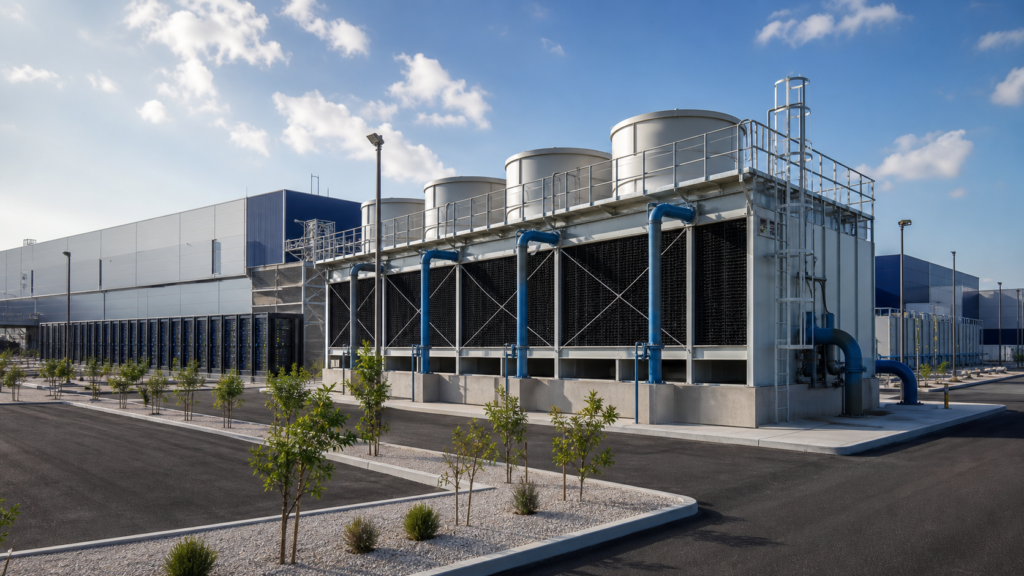
Data Center & AI Computing Center Cooling Solutions
Data centers and AI computing facilities require continuous, predictable heat rejection. HACST helps operators and engineering teams compare dry, adiabatic and closed-loop cooling options around uptime, water strategy, climate, footprint and future capacity.
Request a Data Center Cooling Proposal
Cooling Challenges for Data Centers
- Heat must be rejected continuously, including during maintenance and partial-load operation.
- Cooling infrastructure must support redundancy, staged capacity and future expansion.
- Water availability, water treatment and discharge requirements vary by site.
- High ambient temperatures can reduce available heat-rejection capacity.
- Noise, footprint, controls and service access must be considered during design.
Available Cooling Approaches
Dry Coolers and Air-Cooled Heat Exchangers
Dry systems reject sensible heat without routine evaporative water consumption. They are useful where water is limited or where a facility prefers a simple air-side heat-rejection loop.
Adiabatic Dry Cooling
Adiabatic systems can add controlled pre-cooling during selected ambient conditions. The water strategy should be defined around local climate, water quality, operating hours and the required design approach temperature.
Closed Circuit Cooling Towers
Closed-loop towers keep the process fluid isolated from the evaporative water circuit. This can help protect the primary loop and support stable operation where fluid cleanliness and system separation are important.
How HACST Supports the Design
- Review IT load, heat-rejection duty and required supply/return temperatures.
- Confirm climate data, water availability, water quality and site elevation.
- Compare dry, adiabatic and closed-circuit configurations for annual operation.
- Check N+1 or other redundancy requirements, controls, sound and service access.
- Prepare a project-specific equipment selection and technical proposal.
Recommended Product Families
Information to Include in an RFQ
Please provide the heat load, fluid type, design flow rate, entering and leaving temperatures, site location, ambient design conditions, water constraints, redundancy target and available footprint. These details allow our engineers to recommend a more reliable configuration.
Frequently Asked Questions
Is a dry cooler always the best choice for a data center?
Not necessarily. The right choice depends on design temperature, climate, water strategy, redundancy, footprint and the rest of the cooling plant. A hybrid or adiabatic approach may be appropriate for some sites.
Can HACST support phased expansion?
Yes. Capacity blocks, headers, controls and service access should be reviewed at the beginning so future modules can be added without redesigning the complete heat-rejection system.
Discuss Your Data Center Cooling Requirements
Data Center Cooling Evidence

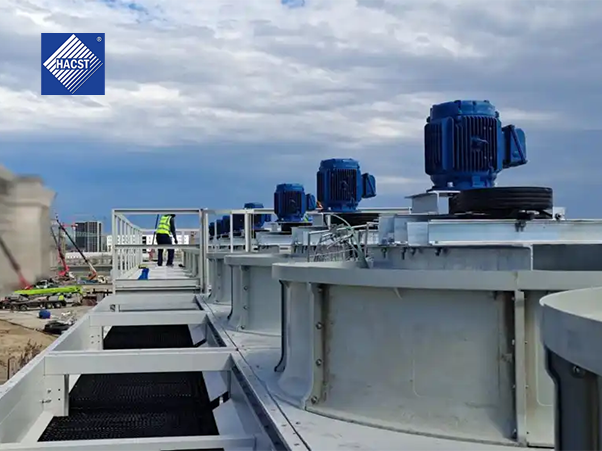
Project Data to Confirm Before Selection
| Heat rejection duty | IT load, chiller duty or liquid-cooling loop heat load |
|---|---|
| Design temperatures | Supply/return temperatures and ambient design condition |
| Water strategy | Dry, adiabatic, closed-loop or hybrid operating preference |
| Reliability | N+1 target, module size, controls and future expansion |
Providing these details helps our engineers prepare a more accurate equipment selection and technical proposal.