
Power Generation Cooling Solutions
Power generation facilities require dependable heat rejection for condensers, auxiliary systems, transformers, compressors and process equipment. HACST helps project teams compare open cooling towers, closed-circuit towers and air-cooled heat exchangers around duty, ambient conditions, water strategy and maintenance requirements.
Request a Power Generation Cooling Proposal
Typical Cooling Duties
- Condensing and auxiliary cooling-water systems.
- Generator, transformer and compressor cooling.
- Gas turbine and power-plant auxiliary equipment.
- Heat exchangers, pumps and process utility loops.
- Cooling systems for renewable and distributed-generation facilities.
Key Engineering Considerations
Power projects must consider continuous operation, redundancy, seasonal ambient conditions, water availability, water chemistry, corrosion, noise, maintenance access and the consequences of reduced capacity. Equipment selection should be based on the complete heat-rejection duty, not nominal fan or tower size alone.
Open Cooling Towers
Open towers can provide efficient central cooling-water service where water treatment, filtration and drift control are compatible with the plant design.
Closed Circuit Cooling Towers
Closed-loop towers can isolate sensitive process fluid from evaporative water and support a cleaner, more controlled primary circuit.
Air-Cooled Heat Exchangers
Air-cooled heat exchangers can reduce dependence on cooling water where the ambient design temperature and available footprint support an air-side solution.
HACST Project Workflow
- Define heat load, fluid type, flow rate and operating temperature range.
- Confirm site climate, water availability and water chemistry.
- Review redundancy, controls, sound, access and future expansion requirements.
- Compare open, closed and air-cooled configurations.
- Prepare equipment selection information for detailed project engineering.
Recommended Product Families
RFQ Information
Please include heat load, process fluid, flow rate, inlet and outlet temperatures, site location, design ambient conditions, water quality, redundancy target and available space.
Frequently Asked Questions
Can an air-cooled heat exchanger replace a cooling tower?
It may be suitable for some duties, but the decision depends on ambient temperature, approach temperature, fan power, footprint and required annual operating range.
How should redundancy be specified?
Redundancy should be evaluated together with the plant load profile, maintenance strategy, module size, controls and the required operating state during equipment downtime.
Discuss Your Power Cooling Project
Power Generation Cooling Evidence
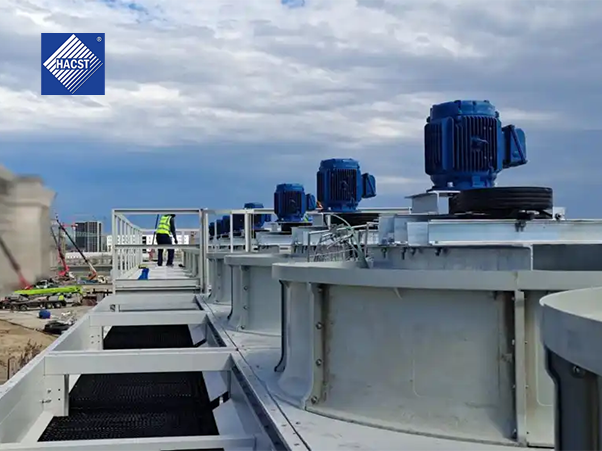

Project Data to Confirm Before Selection
| Plant duty | Condenser, auxiliary, generator or transformer cooling load |
|---|---|
| Operating range | Flow, temperatures and seasonal ambient conditions |
| Water strategy | Availability, chemistry, treatment and discharge requirements |
| Reliability | Redundancy, controls, access and expansion plan |
Providing these details helps our engineers prepare a more accurate equipment selection and technical proposal.