Data centers and AI computing facilities create concentrated, continuous heat loads. Selecting the right heat-rejection system is therefore a design decision that affects uptime, energy use, water strategy, maintenance planning and future expansion. This guide explains how to compare closed circuit cooling towers, dry coolers and adiabatic cooling systems for modern digital infrastructure.
Why data center cooling requires a different approach
Unlike many intermittent industrial processes, data center cooling must support long operating hours, changing IT loads and strict availability targets. The cooling system should be evaluated as part of the complete heat-rejection path: IT equipment or liquid-cooling loops, heat exchangers, pumps, controls and outdoor cooling equipment.
For an early technical review, define the peak and normal heat load, supply and return temperatures, design ambient conditions, water availability, redundancy philosophy, sound limits and available footprint. These inputs allow engineers to compare technologies on operating performance rather than nameplate capacity alone.
Three common heat-rejection options
1. Closed circuit cooling towers
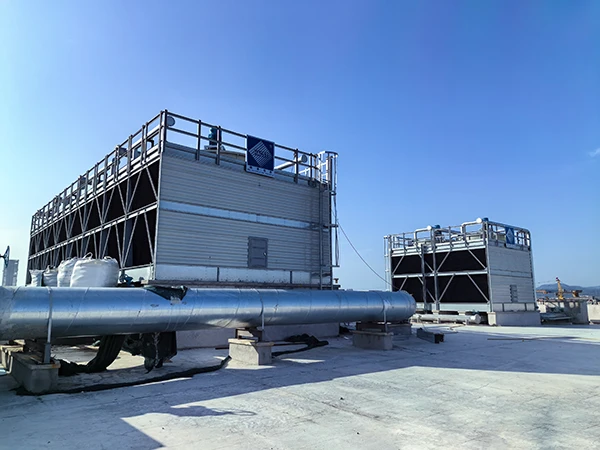
Closed circuit cooling towers keep the process fluid inside a coil while water and air remove heat externally. This separation can help protect sensitive loops from airborne contamination and simplify water-quality management. They are often considered for facility water loops, liquid-cooling secondary circuits and applications that benefit from an approach temperature below a dry-only design.
Key questions include coil material, freeze protection, water treatment, maintenance access, fan control range and whether the system needs N+1 redundancy. Explore HACST closed circuit cooling tower solutions for a closer look at available configurations.
2. Dry coolers and air-cooled heat exchangers
Dry coolers reject heat to ambient air through finned coils and fans, with little or no process water consumption during normal operation. This can be attractive where water is limited, discharge is restricted or water treatment needs to be minimized. The trade-off is that capacity and leaving-fluid temperature depend more directly on dry-bulb ambient conditions.
Dry systems are commonly used in cooler climates, for economizer-style operation, or where the design can tolerate higher fluid temperatures. Air-cooled heat exchangers can also form part of a modular heat-rejection strategy.
3. Adiabatic cooling systems
Adiabatic dry coolers combine air-cooled coils with controlled pre-cooling during high ambient conditions. The system can operate in dry mode for much of the year, then use water only when additional capacity is needed. This approach may balance water reduction with peak-temperature performance, but it requires careful control logic, water-quality planning and local climate analysis.
Learn more about dry and adiabatic cooling systems and the operating conditions that influence their selection.
How to compare options for an AI or high-density data center
| Selection factor | What to assess |
|---|---|
| Heat load profile | Peak load, base load, future IT expansion and the effect of liquid cooling. |
| Climate | Design dry-bulb and wet-bulb temperatures, seasonal hours and extreme weather conditions. |
| Water strategy | Availability, quality, treatment, discharge rules and annual water-use targets. |
| Resilience | N, N+1 or 2N architecture, independent electrical feeds, bypass capability and maintenance isolation. |
| Efficiency | Fan turndown, EC fan options, variable-speed pumps, control sequences and partial-load performance. |
| Site constraints | Footprint, roof loading, sound limits, access for service and crane or lift planning. |
Design principles that improve operational resilience
- Plan for maintenance: Provide isolation valves, clear access paths and sufficient spacing for coil, fan and water-system service.
- Use staged capacity: Multiple modules can support redundancy and improve part-load operation when controls are commissioned correctly.
- Match controls to the system: Fan speed, pump control, basin management and adiabatic operation should be coordinated with the facility control strategy.
- Protect the cooling loop: Define filtration, water treatment, glycol protection where required and monitoring points before equipment selection.
- Design for expansion: Reserve hydraulic, electrical and physical capacity where additional IT halls or AI clusters are planned.
Start with project data, not a product preference
A cooling tower, dry cooler or adiabatic system can all be appropriate in the right conditions. The most reliable choice comes from matching the equipment to the operating envelope, site constraints and resilience target. HACST can review project data and recommend a suitable industrial cooling configuration for data centers, high-performance computing and liquid-cooling infrastructure.
Explore Data Center Cooling Solutions Request a Technical Proposal