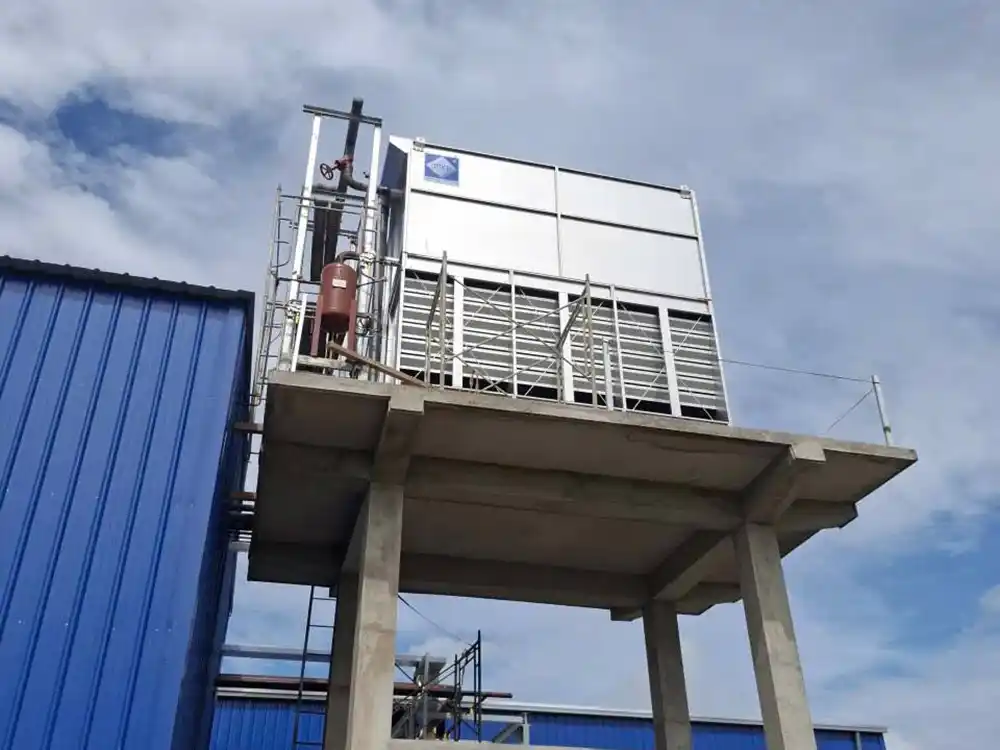
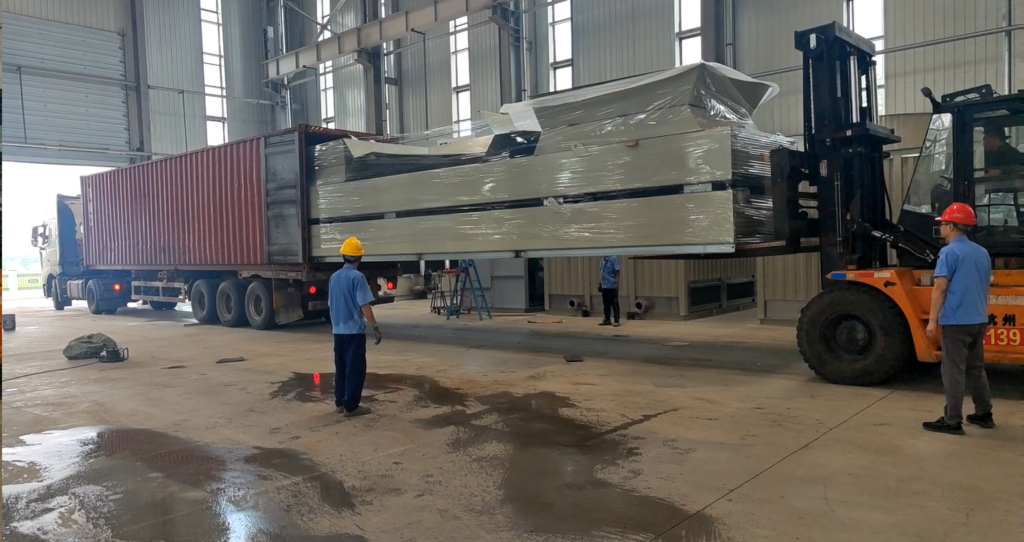
A closed circuit cooling tower and an evaporative condenser can look similar because both use a coil, spray water and airflow. They are not interchangeable, however. The decisive difference is what flows inside the coil and what duty the equipment performs in the overall system.
Quick selection answer
- Use a closed circuit cooling tower when the unit cools water, glycol or another process fluid that must remain in a clean, closed loop.
- Use an evaporative condenser when the coil receives refrigerant vapor and must condense it into liquid as part of a refrigeration system.
- Do not select by appearance alone. Confirm fluid type, pressure, temperature, heat load, design wet-bulb temperature and applicable pressure-vessel requirements.
How the two systems work
In a closed circuit cooling tower, process fluid circulates through the coil. Spray water recirculates over the outside of the coil while air removes heat. The protected process loop can serve chillers, compressors, induction furnaces, data-center water loops and many industrial machines.
In an evaporative condenser, hot refrigerant vapor enters the coil, rejects heat and condenses. The unit replaces the separate condenser-water loop used in some conventional refrigeration layouts. Refrigerant selection and design pressure therefore become central engineering inputs.
Side-by-side engineering comparison
| Selection factor | Closed circuit cooling tower | Evaporative condenser |
|---|---|---|
| Fluid inside coil | Water, glycol, oil or compatible process fluid | Refrigerant vapor/liquid |
| Primary duty | Cool a circulating process fluid | Condense refrigerant |
| System connection | Process or secondary cooling loop | Refrigeration discharge and liquid line |
| Key design inputs | Flow, inlet/outlet temperature, fluid properties, wet bulb | Refrigerant, condensing duty, pressure, wet bulb, compressor data |
| Typical applications | Industrial process cooling, HVAC loops, data centers, power and manufacturing | Cold storage, food freezing, ice plants and industrial refrigeration |
| Compliance focus | Fluid compatibility, water treatment, electrical and structural requirements | All cooling requirements plus refrigerant and pressure-vessel rules |
Efficiency and operating cost
Both technologies use evaporative heat rejection and can approach the ambient wet-bulb temperature more closely than dry-only equipment. Project efficiency depends on fan and pump power, coil cleanliness, airflow, water distribution, control sequence and the operating load profile. A valid comparison must use the same design conditions and annual operating hours.
An evaporative condenser may reduce the number of heat-transfer stages in a refrigeration plant. A closed circuit tower offers flexibility because it isolates the process loop and can be connected to different types of loads. Neither advantage guarantees the lowest lifecycle cost without a complete system calculation.
Maintenance and water management
- Maintain spray-water chemistry, filtration and blowdown to limit scale, corrosion and biological growth.
- Inspect nozzles, strainers, basin, drift eliminators, fans, motors and coil surfaces.
- Protect idle coils and piping against freezing where winter temperatures require it.
- For evaporative condensers, coordinate inspection and service with the refrigerant-safety plan and qualified refrigeration personnel.
Information needed for selection
- Required heat rejection or refrigeration condensing load.
- Process fluid or refrigerant and its concentration or operating condition.
- Flow rate, entering and leaving temperatures, and allowable pressure drop.
- Design summer wet-bulb temperature and winter minimum dry-bulb temperature.
- Water quality, available footprint, sound limit, altitude and electrical supply.
- Material, certification and local code requirements.
How HACST can help
HACST manufactures both closed circuit cooling towers and evaporative condensers, allowing the engineering discussion to start with the system duty rather than a single product. Send the operating-condition sheet through Contact HACST for equipment selection and layout review.
FAQ
Can a closed circuit cooling tower condense refrigerant?
A standard closed circuit cooling tower is selected to cool a liquid process stream. Direct refrigerant condensing requires an evaporative condenser engineered for the refrigerant, pressure and applicable codes.
Do both units require water treatment?
Yes. Their recirculating spray-water circuits require a managed water program even though the fluid inside the coil remains separated from the atmosphere.