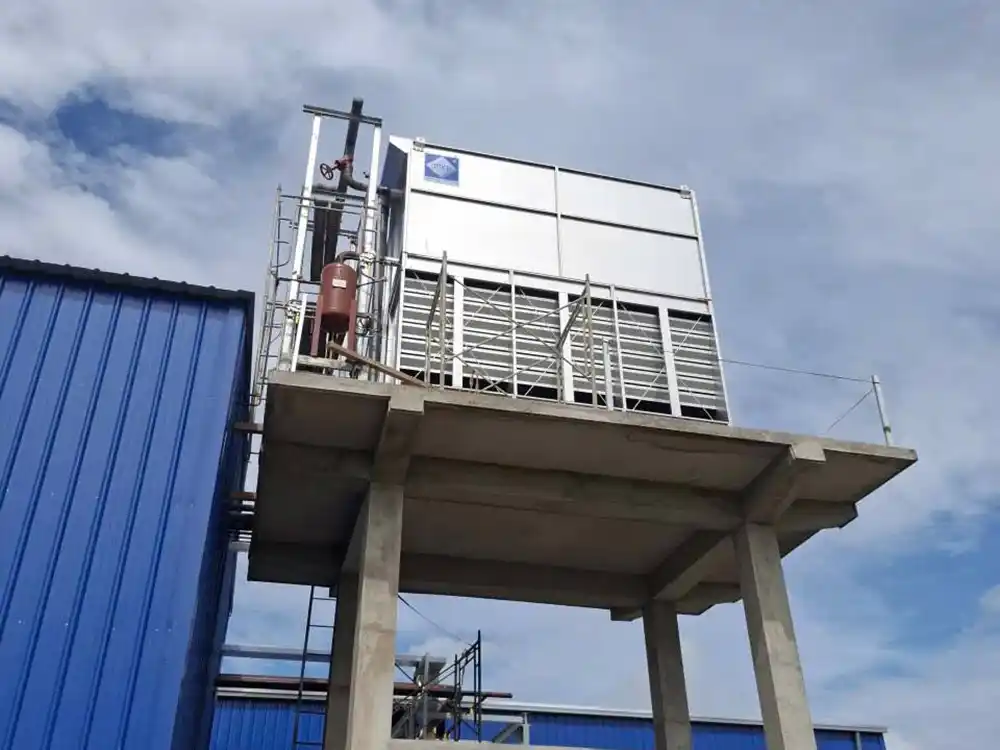
Dry coolers and evaporative condensers reject heat to outdoor air, but they solve different system problems. A dry cooler normally cools a liquid without consuming process water, while an evaporative condenser condenses refrigerant and uses evaporation to lower the effective heat-rejection temperature.
Quick decision guide
- Choose an industrial dry cooler when water conservation, simple winter operation or separation from refrigerant is the priority.
- Choose an evaporative condenser for refrigeration duties where lower condensing temperatures and compact evaporative heat rejection justify water treatment.
- Consider an adiabatic cooler when a mostly dry system needs limited evaporative assistance during peak weather.
Operating principle
A dry cooler moves ambient air across a finned coil. Water, glycol or another compatible liquid remains inside the coil and rejects sensible heat to the air. The leaving fluid temperature is limited by the outdoor dry-bulb temperature plus the selected approach.
An evaporative condenser sprays recirculating water over a refrigerant coil while fans move air through the unit. Evaporation helps reject both sensible and latent heat, so design performance relates to outdoor wet-bulb temperature. Refrigerant vapor condenses inside the coil.
Comparison table
| Factor | Dry cooler | Evaporative condenser |
|---|---|---|
| Heat sink | Outdoor dry-bulb temperature | Outdoor wet-bulb temperature |
| Water consumption | None in fully dry mode | Makeup water required |
| Fluid inside coil | Water, glycol, oil or process fluid | Refrigerant |
| Water treatment | Not required for a closed dry coil | Required for recirculating spray water |
| Peak summer temperature | Usually higher | Usually lower for the same climate |
| Winter operation | Straightforward with suitable glycol/control | Requires freeze-protection planning |
| Common use | Data centers, process loops, free cooling, water-sensitive sites | Cold storage, food processing, ice plants, industrial refrigeration |
Energy must be evaluated at system level
Fan power alone does not decide the most efficient option. A dry cooler operating at a higher fluid temperature may increase chiller or process energy. An evaporative condenser can reduce refrigerant condensing temperature but adds spray-pump power and water-management requirements. Model compressor, fan, pump and water use across the annual weather profile.
Water, climate and site constraints
Dry cooling is attractive where water is expensive, restricted or difficult to treat. Coil fin spacing and air quality still matter because dust, pollen and industrial contamination can reduce airflow. Evaporative equipment is often compact for a given duty, but makeup-water quality, cycles of concentration, blowdown and drift control must be included in the design.
Data required before requesting a quotation
- Heat load and annual load profile.
- Fluid or refrigerant, concentration, operating pressure and allowable pressure drop.
- Entering and leaving temperatures.
- Design dry-bulb and wet-bulb temperatures, altitude and winter minimum.
- Water availability and chemistry.
- Footprint, sound, plume, redundancy and control requirements.
Selection support
HACST supplies dry coolers, adiabatic cooling systems and evaporative condensers. Share your operating conditions through our engineering contact form so the alternatives can be compared on the same thermal basis.
FAQ
Can a dry cooler directly replace an evaporative condenser?
Not usually. The equipment handles different fluids and temperatures. A system redesign, including a separate refrigerant condenser or secondary loop, may be required.
Which option uses less water?
A fully dry cooler uses no evaporative makeup water. An adiabatic unit uses water only under selected conditions, while an evaporative condenser normally uses water whenever the spray system operates.